



Moon and Half Dome, Yosemite National Park, 1960
- Image
- 19¾ × 14⅞in
- Mount
- 28 × 21⅞in
- Image
- 1960
- Printed
- c. 1970
- Material
- Silver Gelatin
- Format
- Mounted
- Edition
- Not editioned
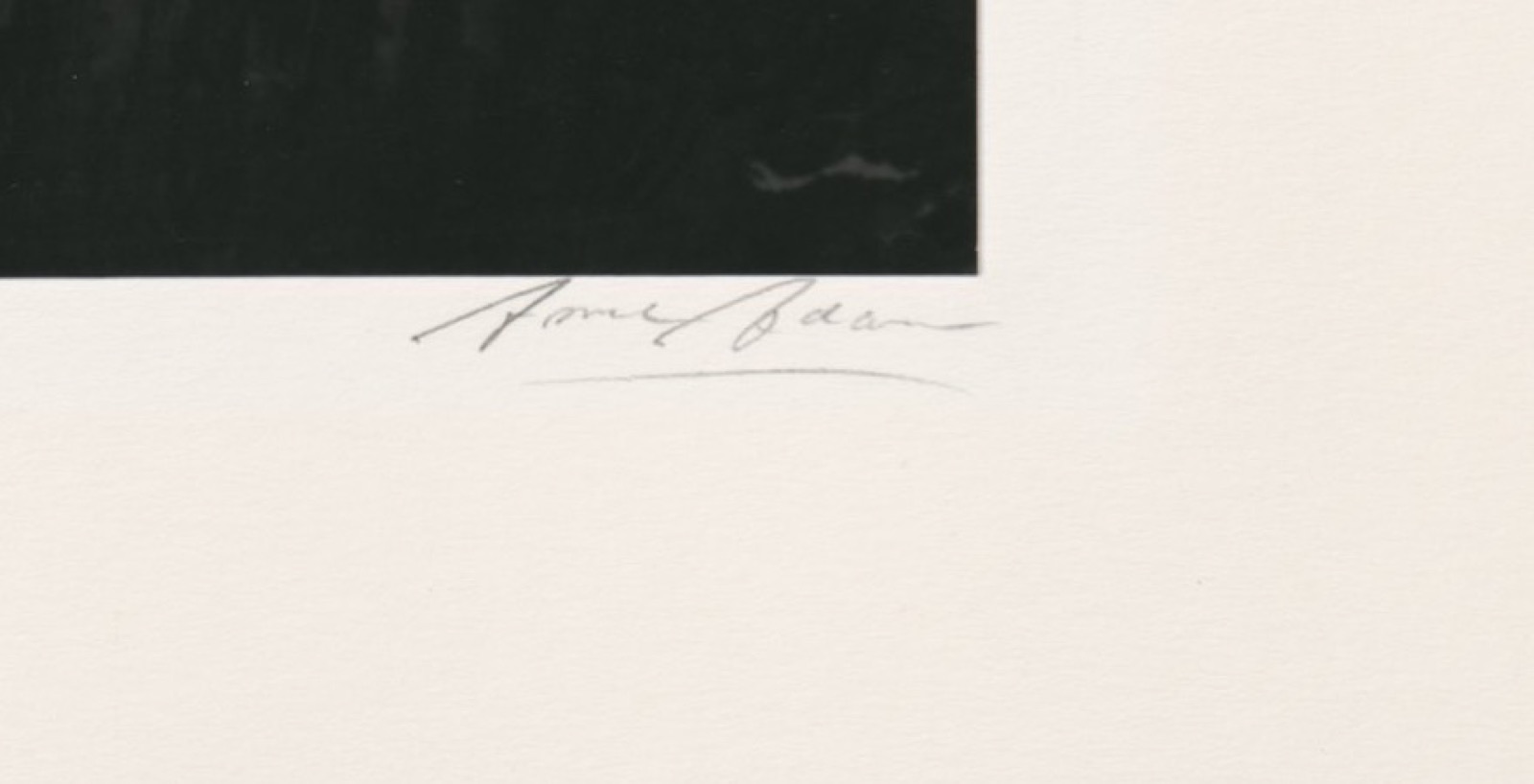
- Signature
- Signed by the artist Signed in pencil beneath the image.
- Rarity
- Around 200 prints by Adams's own hand — Andrea Stillman, Looking at Ansel Adams, 2012.
- Verso
- The photographer's Carmel studio stamps (BMFA 7 and 8), titled in ink “Half Dome & Moon, Yosemite National Park”, on the reverse of the mount; two inventory numbers in pencil along the bottom edge
-
Kodak Bromesko, 1970
The paper was photographed at microscopic resolution under raking light and compared against a reference library of dated papers. This is not a definitive match — but it lines up with the studio stamps, the type of mount board, and the slightly darker print tones of this example, which together place this print at about 1970. The texture is kept on record as this print's fingerprint. A paper match is dating evidence, never authentication.
Surface and Relight combine measured relief with simulated light and gloss. Surface contrast is increased for visibility. These images may contain artifacts from the scanning process.
This gelatin silverThe standard black-and-white print process: silver suspended in a gelatin emulsion on paper. print, dry-mounted to board, is in overall excellent condition.
- Spots of original retouchingSmall additions of media applied by hand to fill losses or even out tone in the image. — the studio's own finishing — visible on close inspection.
- Otherwise the print shows no notable defects.
- A few very minor edge bumps along the bottom edge and at the top-left corner.
- Linen tape along the top edge of the mountThe board or secondary support a print is adhered to. rectoThe front of the sheet — the side carrying the photographic image..
- The board is evenly toned throughout — a slight warm tone.
- This thin board is more prone to warping and light-toning than heavier boards, and prints on it often show mat burn at the edges — this example shows no darkening or yellowing around the print.
- Slightly warmer in tone than the front, with scattered fingerprints and a few faint discoloration spots.
Provenance is compiled from documents and owner accounts and may be incomplete.
A picture so precise the sky can date it.
Driving toward the Ahwahnee Hotel one winter afternoon, Ansel Adams saw the finished photograph in his mind before the car had stopped — the moon beside Half Dome, the shadow climbing the great cliff. He crossed the snowy meadow on foot and made the exposure. Thirty-four years later, astronomers worked backwards from the picture alone and recovered the moment: December 28, 1960, 4:14 p.m., to about a minute.
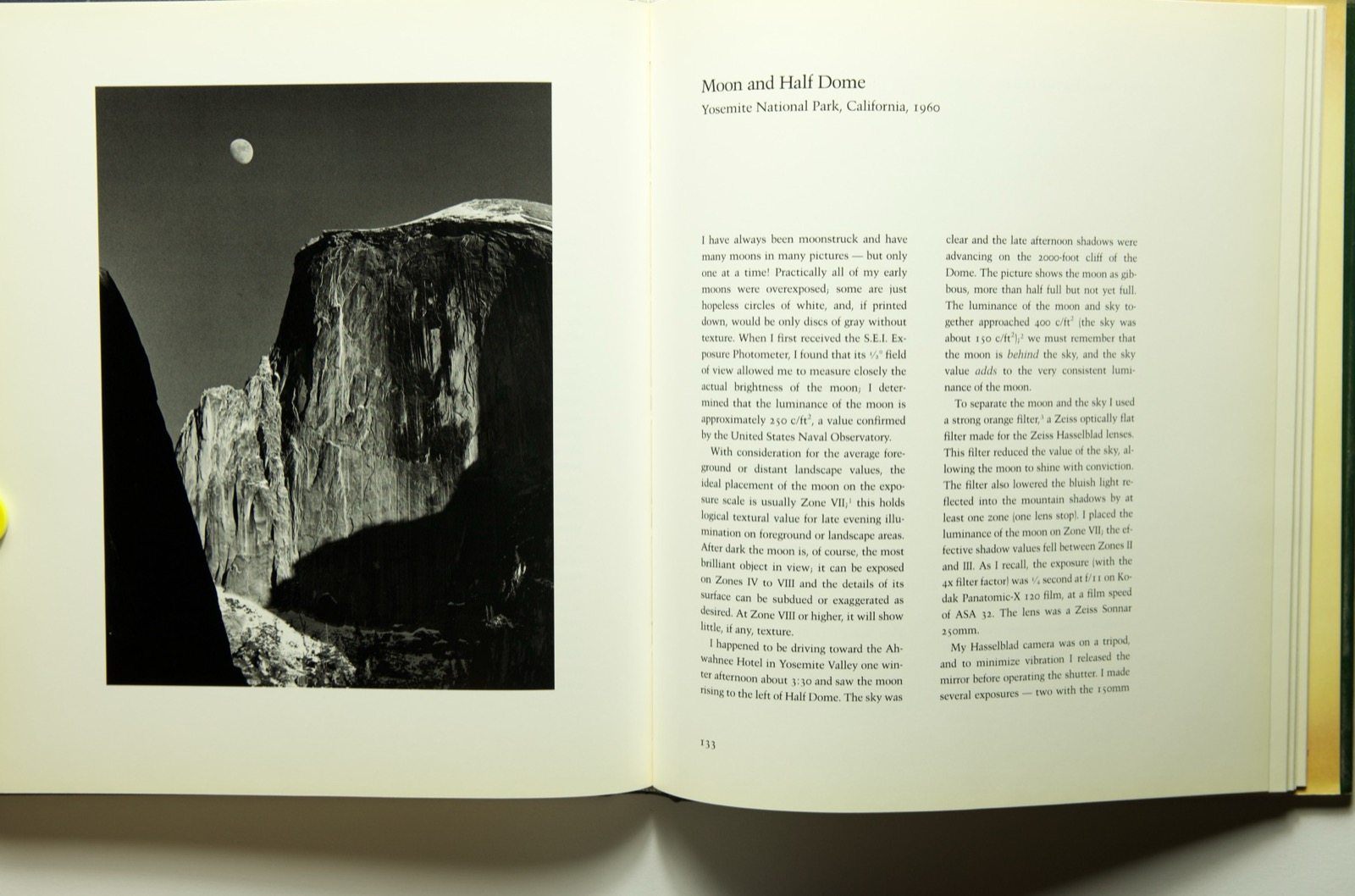
“I have always been moonstruck… many moons in many pictures — but only one at a time!”
He was fifty-eight, and he had been photographing this valley for forty-four years — since 1916, when a fourteen-year-old with a Kodak box camera talked his parents into a Yosemite vacation. He married Virginia Best, whose father kept the painter’s studio below Sentinel Rock; her gallery, Best’s Studio, would sell his prints to park visitors for the rest of the century. He had served on the Sierra Club’s board since 1934, and that same year, 1960, the club published This Is the American Earth — his book with Nancy Newhall that became a founding text of the modern conservation movement.
The tool of his late career had come as a gift: Victor Hasselblad sent Adams one of his cameras in 1950, and the two men corresponded for years as Adams tested and helped refine it. “New seeing with Hasselblad!” he wired the Newhalls. By 1960 the square-format camera rode with him everywhere — which is why, when the moon appeared beside Half Dome, the picture could be made from the trunk of a car.
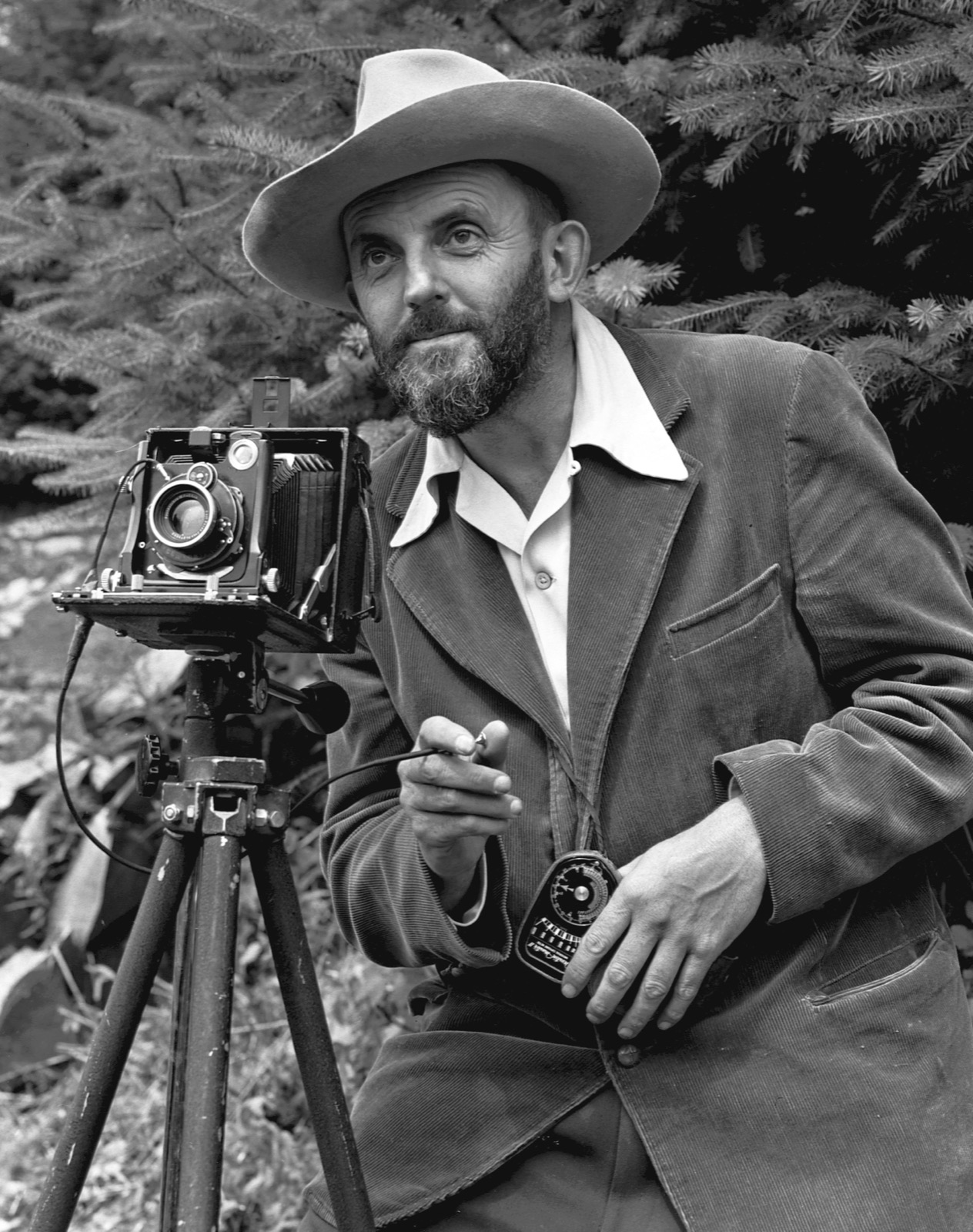
“I was driving a bit aimlessly around the valley,” Adams remembered, “when I clearly saw an image in my mind’s eye of Half Dome as the moon rose over its right shoulder. I parked my car and with my Hasselblad and tripod firmly positioned across my shoulder, I strode over the snowy field in front of the Ahwahnee until I found the place that best revealed the scene.” The sky was clear, and late-afternoon shadows were advancing on the 2,000-foot cliff of the Dome.
On the tripod: the Hasselblad 500C, a 250mm Zeiss Sonnar to compress the space between moon and mountain, and a Zeiss orange filter to darken the sky so the moon could “shine with conviction.” To keep the camera still he released the mirror before firing the shutter — the moon moves its own width every two minutes, and at this magnification there was no room for blur.
In 1994 an astronomy class at Texas State reconstructed this afternoon from the photograph alone — the moon’s height and phase, the tilt of its face, weather logs, and the angle of the Diving Board’s shadow — and fixed the exposure at 4:14 p.m., ±1 minute.
Olson et al., Sky & Telescope, Dec 1994
Adams knew the moon’s luminance by heart — 250 candles per square foot, a number he had first used to save Moonrise, Hernandez in 1941, measured with his S.E.I. photometer’s half-degree spot and later “confirmed by the United States Naval Observatory.”
The proof sheet survives: “twelve exposures, an entire roll” of 120 film, as his biographer counted them. Adams waited “until the moon rose to a favorable position” and exposed at intervals of about a minute — two frames on the wider 150mm Sonnar, “by no means as effective” as the 250 — uncharacteristic patience from a man who called bracketing “nothing but indecision.”
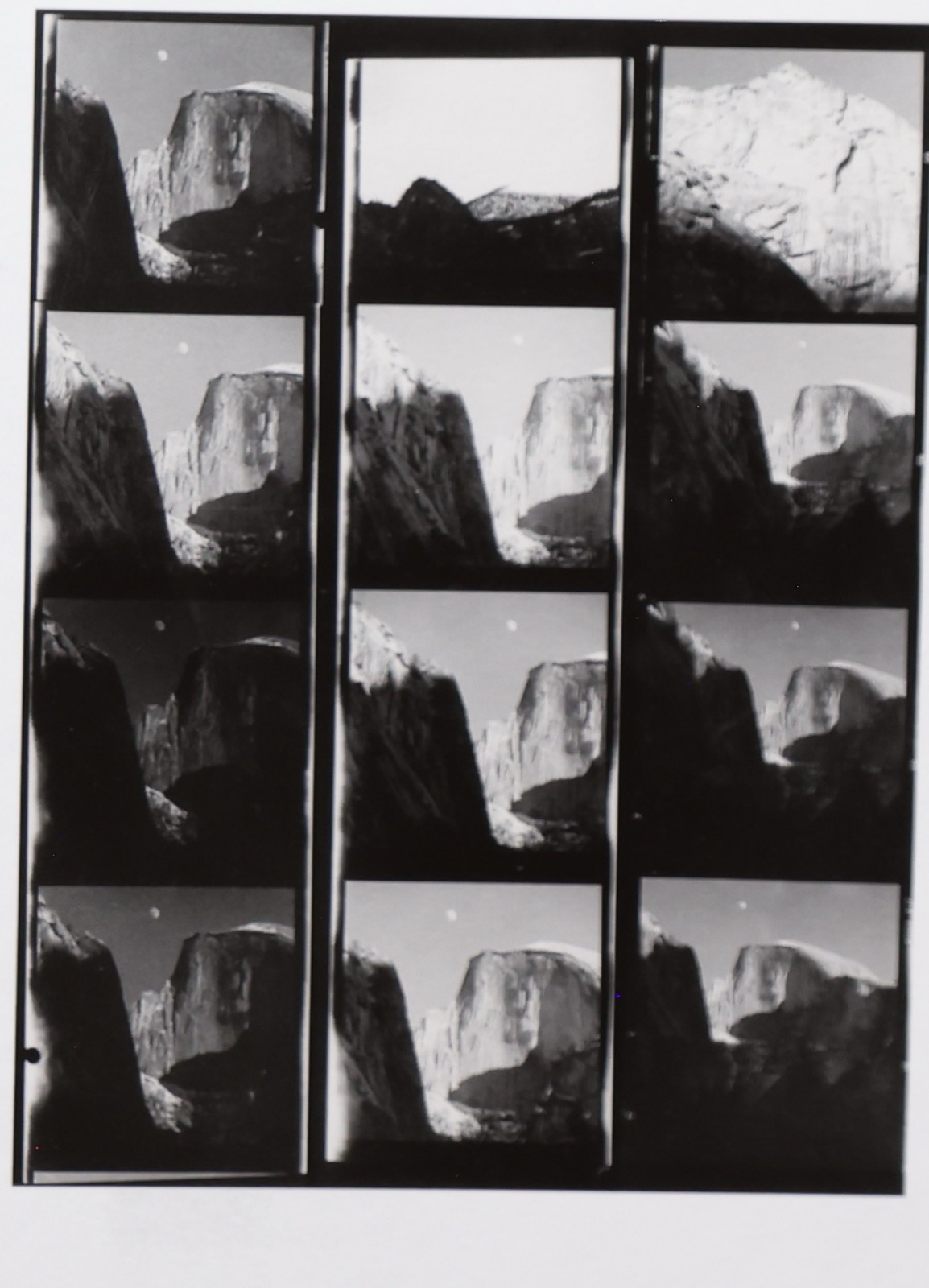
Even the choice of negative moved. Adams’s first pick — marked with his darkroom hole punch — gave way after years of printing to a neighbor on the same roll, the negative that still makes the Special Edition prints today. And the film itself carries a story: Adams remembered Kodak Panatomic-X; Alan Ross, who still prints from this roll, reads its edge markings as Adox R17. Every print is a vertical crop from these squares — “the cropping closely determined from the start” — except his one mural, which keeps the negative nearly square.
The Ahwahneechee called it Tis-sa-ack, for the woman of the legend whose face darkens the cliff. Geologists say the “missing half” was never there: the dome grew as granite cooled deep underground, then shed its face in sheets along the rock’s own joints as glaciers cut the valley below. It was called unclimbable until George Anderson drilled his way up the summit route in 1875. Adams gave it the last word himself: mountaineers had told him “the three most distinctive mountain shapes in the world are the Mustagh Tower in the Karakorams, the Matterhorn in the Alps, and Half Dome in Yosemite.”
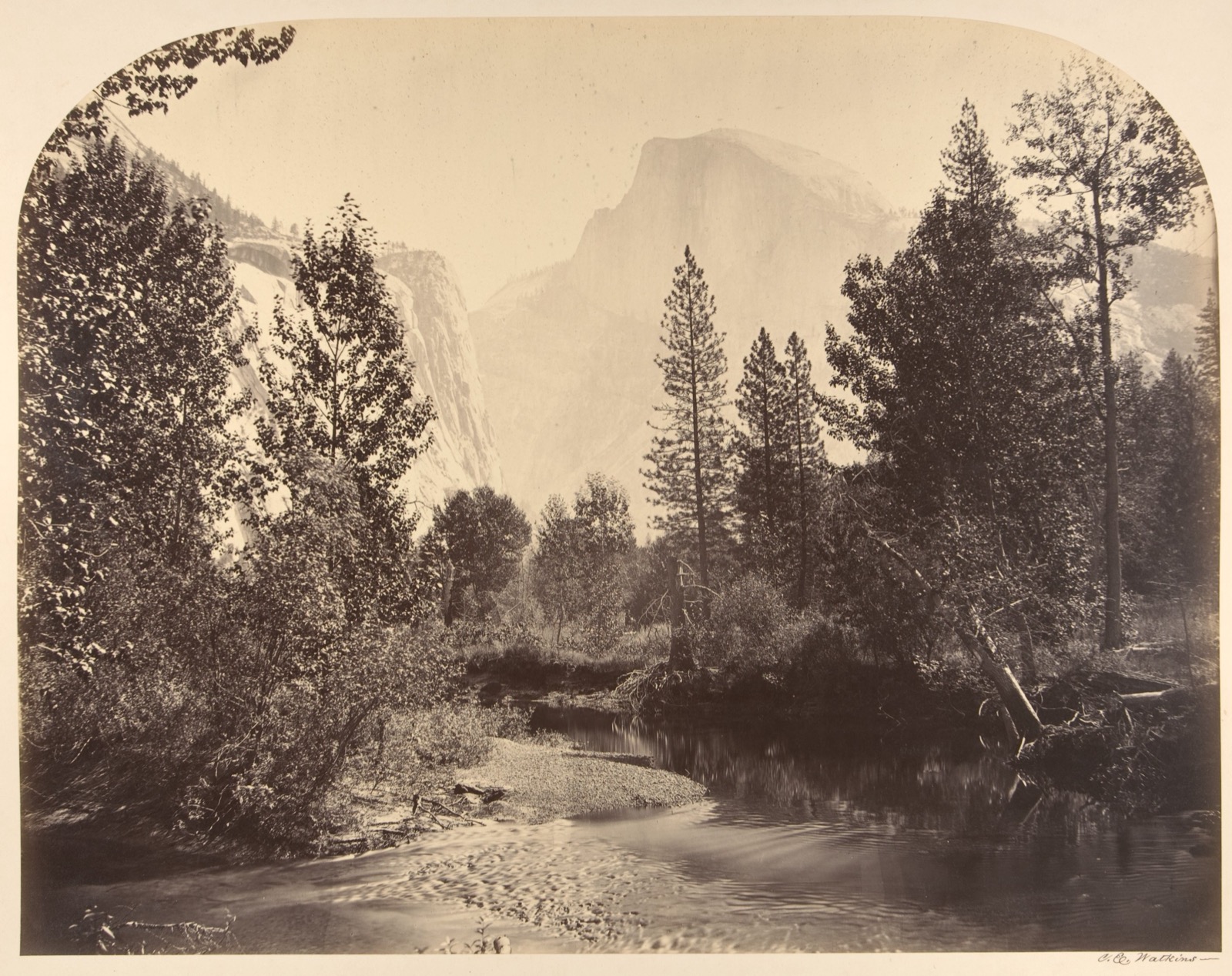
Photography and this mountain grew up together. Watkins hauled a mammoth-plate camera into the valley in 1861, and his prints helped persuade Congress to protect Yosemite in 1864 — the first time the United States set aside wild land for its own sake. A century of photographers later, Adams answered the same face twice: Monolith in 1927, close and vertiginous, and this picture in 1960 — the mountain composed, at last, with its moon.
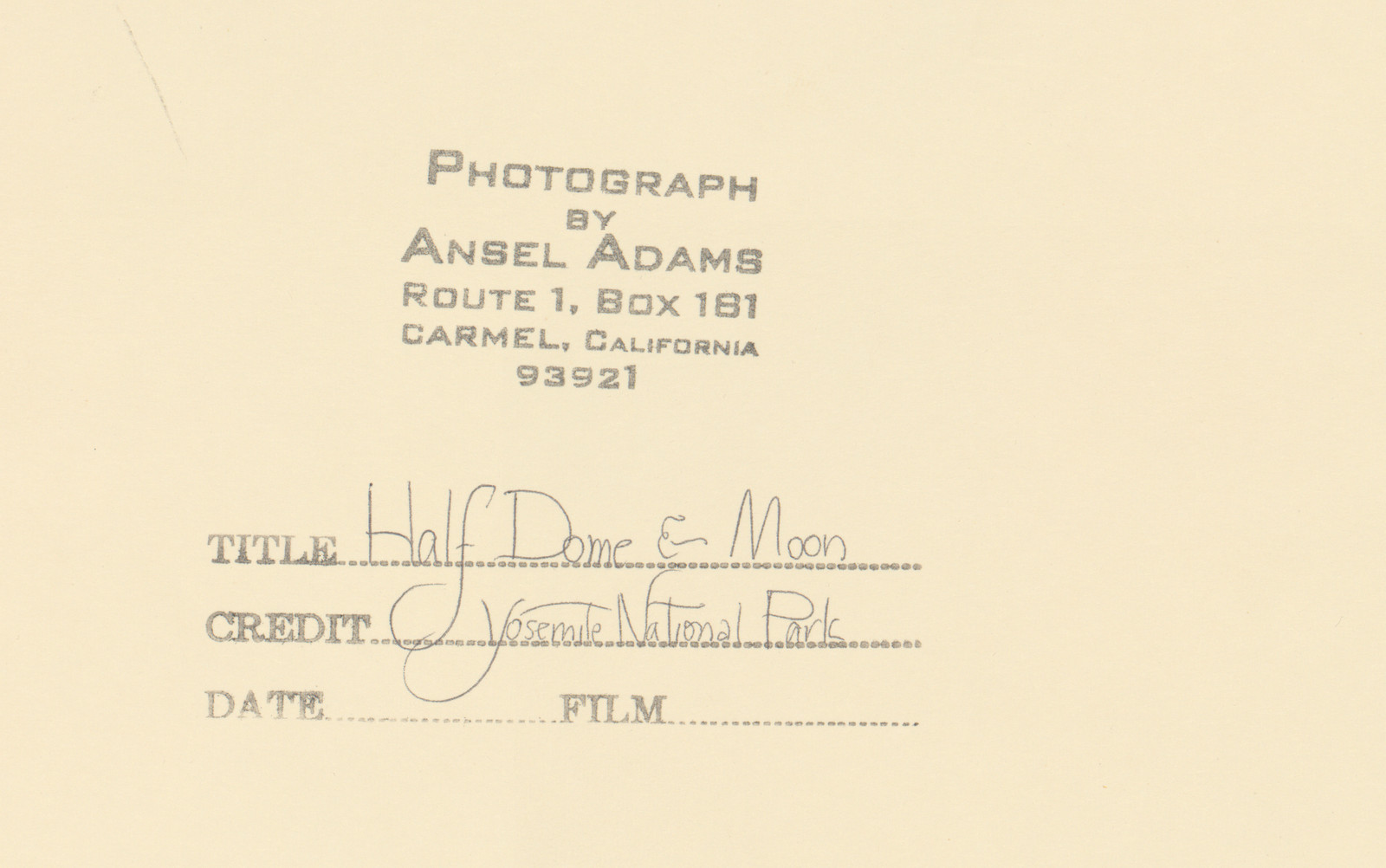
The dating is written on the back. Adams stamped his mounts with the studio credit of the moment, and the sequence of those stamps is scholarship — Karen Haas and Rebecca Senf, of the Museum of Fine Arts, Boston, published the standard chronology. This mount carries stamps 7 and 8, the pair in use from 1963 to 1973 — after his move to Carmel, before the late-seventies stamps of his final printing years. Beside the stamps, a period hand has titled it in ink “Half Dome & Moon” — in those years the picture’s name hadn’t yet settled; the Museum of Fine Arts, Boston holds a 1962 print inked “Moonrise – Half Dome.”
This story was researched and written with Vault’s AI from the sources above. It can make mistakes — check the sources yourself.